Key Takeaways
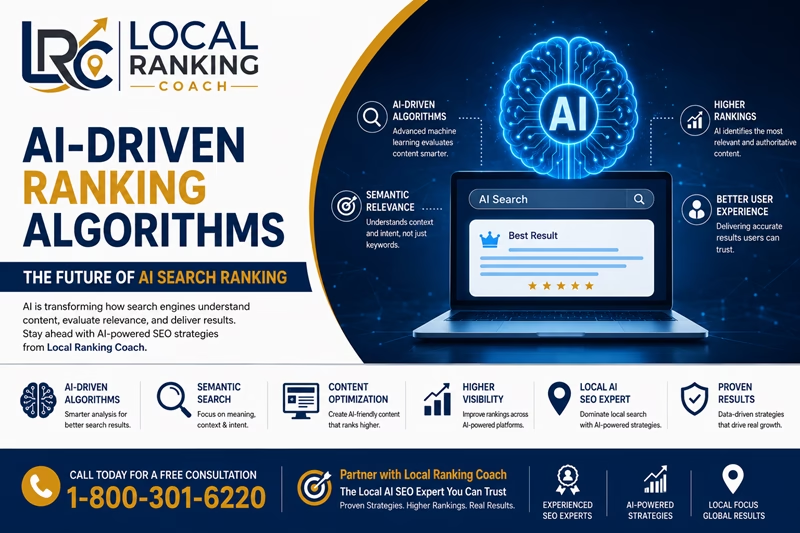
AI-driven ranking algorithms now power Google, Bing, YouTube, Amazon, online marketplaces, recommender systems, and major digital platforms by using neural networks, semantic relevance, and user behavior instead of simple keyword matching.
Modern ranking models use pointwise ranking, pairwise ranking, and listwise ranking approaches, often combined with neural ranking architectures such as BERT-based models, LambdaMART, and other advanced machine learning systems trained on large interaction logs.
Semantic relevance, e e a t, user experience, structured data, and engagement signals are now central to AI search ranking across web search, local results, Google AI Overviews, and AI-generated answers.
Businesses need content, technical seo, internal linking, and site architecture that are machine-readable, semantically rich, and aligned with user intent to protect search rankings from 2024 through 2026.
Local Ranking Coach helps companies turn these complex ranking model ideas into practical local AI SEO campaigns focused on visibility, calls, leads, and business growth.
Introduction: From Classic SEO to AI-Driven Search Ranking
Search used to be easier to understand. If a page had enough links, used the right keywords, and matched the input query closely, it had a good chance of appearing near the top of the search results.
That era is over.
Since RankBrain in 2015, BERT in 2019, Multitask Unified Model, and the 2023–2026 wave of Google AI updates, search engines have moved from keyword matching toward natural language understanding, neural network ranking, and large-scale behavioral learning. Modern AI algorithms do not just ask, “Does this page contain the phrase?” They ask, “Does this page satisfy the user intent behind this given query better than every other relevant document?”
This blog post explains how AI-driven ranking algorithms work, how they use data points, feature vectors, training data, ranking metrics, and user interactions, and what businesses should do to stay visible in AI-powered search.

What Are AI-Driven Ranking Algorithms?
AI-driven ranking algorithms are ranking systems that sort and prioritize items based on predicted relevance or value to a specific user, query, or context. Those items can be web pages, local businesses, products, videos, songs, or answers.
Instead of relying only on static rules, a ranking model analyzes signals such as semantic meaning, authority, freshness, page speed, reviews, past behavior, and engagement. It then assigns relevance scores and produces a ranked list.
You see this every day:
Google ranks web pages for a web search.
YouTube ranks videos.
Amazon ranks products.
Netflix and Spotify use collaborative filtering and deep reinforcement learning to rank media libraries.
Local search ranks businesses by proximity, reputation, and relevance.
Definition of AI-Driven Ranking Algorithms
AI-driven ranking algorithms are artificial intelligence systems that use machine learning and neural networks to predict a ranking order of candidates, such as pages, products, or businesses, for a query dependent context.
In practice, these systems convert a query and candidate result into feature vectors. These feature vectors can include:
Feature type | Example signals |
|---|---|
Textual relevance | BM25, headings, semantic embeddings, document length |
Authority | links, citations, reviews, expert references |
Engagement | clicks, dwell time, scroll depth, pogo-sticking |
Technical quality | mobile usability, Core Web Vitals, crawlability |
Local context | proximity, Google Business Profile data, NAP consistency |
Structured meaning | schema, entities, semantic relationships |
A model then tries to predict relevance. If one page has stronger relevance scores, better trust signals, and stronger satisfaction signals than another, it may be ranked higher. |
Older ranking algorithms leaned heavily on PageRank, keyword frequency, anchor text, and probabilistic models. Those earlier methods still influence search, but modern ranking systems use advanced machine learning to learn from clicks, assessor judgments, and large-scale user behavior.
AI ranking can also happen in stages. A fast retrieval system finds possible results. Then a more expensive neural ranking system may re rank the best candidates with deeper semantic similarity analysis.
Why AI Ranking Algorithms Matter for SEO and Business Growth
AI ranking algorithms matter because search is no longer one-size-fits-all.
A search for “best dentist near me” may show different ranking results based on location, device, previous searches, reviews, and how similar users interact with listings. AI ranking algorithms analyze user behavior signals, such as clicks and engagement metrics, to tailor search results to individual preferences.
That personalization can be helpful, but it has risks. AI prioritizes engagement, which can create filter bubbles and echo chambers that limit diverse perspectives. AI systems can also perpetuate inequality if the training data contains historical prejudices.
For businesses, the opportunity is clear: better AI search visibility can lead to more calls, more qualified traffic, lower paid ad dependency, and compounding brand visibility. But the strategy has to change. Machine learning models are efficient at detecting and penalizing manipulative or keyword-stuffed content, so businesses need depth, trust, and usability.
Google AI Overviews make this even more important. Google began rolling AI Overviews out widely in the U.S. in 2024 and later expanded them to many countries. These AI-generated search results rely on ranking systems to decide which passages are reliable enough to summarize and cite. Google explains the feature in its AI Overviews update.
Core Components of Modern AI Ranking Systems
Modern AI ranking systems usually combine several technologies:
Natural Language Processing (NLP): Interprets natural language, entities, synonyms, and intent.
Machine learning models: Learn from a training dataset of judgments, clicks, and engagement.
Semantic indexing: Stores content by meaning, not only exact words.
Entity recognition: Identifies people, places, brands, services, and products.
User intent analysis: Determines whether the query is informational, local, commercial, or transactional.
Contextual understanding: Uses location, device, session history, and past behavior.
Neural models may include transformer encoders such as BERT and RoBERTa. BERT stands for bidirectional encoder representations from transformers, and it helps systems understand context from both sides of a word or phrase.
Other systems use dual encoders for fast retrieval, cross-encoders for precise re-ranking, and gradient-boosted models such as LambdaMART on engineered features.
How AI Search Algorithms Work Under the Hood
A typical AI search pipeline looks like this:
The system receives an input query.
It interprets user intent.
It retrieves possible candidates.
It scores those candidates using a ranking model.
It applies personalization, safety, spam, and UX rules.
It outputs a ranked list of relevant results.
Learning to rank (LTR) is a class of supervised machine learning algorithms that sorts a list of items in terms of their relevance to a query, transforming the ranking task into a classification or regression problem.
There are three principal methods of ranking algorithms: pointwise, pairwise, and listwise, each with different approaches to how they process and rank items based on relevance.
From Query to Ranked List: The AI Search Pipeline
Imagine someone searches “emergency plumber in Austin.”
The system may:
Detect urgent local intent.
Infer the user’s location.
Retrieve plumbing service pages and Google Business Profiles.
Score candidates by proximity, reviews, service relevance, authority, and availability.
Re rank results based on likely satisfaction.
Pointwise ranking scores each result independently. This often treats the ranking task like a regression problem where the model predicts a relevance score for each page.
Pairwise ranking compares two results at a time. For example, if users consistently choose Plumber A over Plumber B after similar searches, the model learns which should appear first.
Listwise ranking evaluates the whole result set together. This is closer to the real search experience because users see a ranking order, not isolated pages. Methods such as LambdaRank and LambdaMART optimize ranking metrics across the list.
Normalized Discounted Cumulative Gain (NDCG) is a key metric used to evaluate ranking models by rewarding them for placing the most relevant items at the top of the list, particularly when graded relevance is important. Mean Reciprocal Rank (MRR) is another evaluation metric that focuses on the position of the first relevant result, which is crucial for tasks like web search where users typically click on the first result that appears relevant.
Related evaluation metrics include reciprocal rank, average precision, precision@k, recall, and other metrics used by data scientists to measure search quality. Some newer research, such as NeuralNDCG, explores differentiable approaches for training models closer to ranking evaluation.
Feature Vectors and Data Points Used for Ranking
AI search engine optimization starts with understanding what ranking signals become data points.
Common signals include:
Click-through rate
Dwell time
Pogo-sticking
Scroll depth
Internal link depth
Core Web Vitals
Mobile friendliness
Review score
Content freshness
Entity coverage
Structured data
Link authority
Semantic similarity
Local proximity
These are assembled into feature vectors for each query-document pair. The model learns patterns from training data and applies them to new data.
User behavior data, including search history and interaction patterns, is crucial for training AI models to improve the relevance of search results. Modern ranking systems utilize feedback from user interactions to continuously adapt and refine their algorithms, ensuring that the results remain relevant over time.
Continuous monitoring of metrics such as click-through rates and precision-recall curves is essential for ongoing performance evaluation of ranking models, allowing for adjustments based on changing user preferences.
There are real-world challenges too. Handling missing values and unstructured data is a common real-world challenge for ranking systems, as user interactions may be incomplete and content can come in various formats, requiring robust feature engineering.
The cold start problem is another significant challenge in ranking systems, where new users or items lack historical data to inform ranking algorithms, making it difficult to provide relevant recommendations immediately.
Neural Ranking Models and Neural Networks in Information Retrieval
Neural ranking uses a neural network to map queries and documents into dense mathematical representations. These embeddings help the system compare meaning, not just words.
Examples include:
monoBERT-style cross-encoders that deeply compare a query and document.
ColBERT-style late interaction models that balance speed and accuracy.
Dual-encoder models that support fast vector search.
LLM-based re-ranking and Retrieval Augmented Generation for AI-generated answers.
This improves information retrieval because the system can understand polysemy, context, and complex queries. For example, “jaguar speed” could mean a car or an animal. A neural ranking model uses context to decide which is more likely.
Advanced deep learning models are complex and create a “black box” problem that complicates understanding rankings. That is why SEO teams should focus less on guessing exact formulas and more on improving the signals AI systems are designed to reward.
Semantic Relevance, E-E-A-T, and User Experience in AI Ranking
AI search ranking is not driven by one magic factor. It blends semantic relevance, trust, UX, and engagement.
Modern AI algorithms prioritize semantic relevance by focusing on the meaning and context behind a user’s query rather than just the individual words used in the search. Semantic relevance is crucial for understanding user intent, which allows AI algorithms to deliver more accurate and contextually appropriate search results.
The shift from keyword-based search to semantic search represents a significant evolution in AI ranking algorithms, enabling them to comprehend complex queries and provide comprehensive answers.
Semantic Relevance and Intent Matching
Semantic relevance means how closely a page’s meaning, entities, and context match the user’s need.
For example:
“How to reduce mortgage payments”
“Refinancing options”
“Lower monthly home loan cost”
These are different phrases, but they share semantic relationships. A strong AI content ranking system can connect them.
To improve semantic SEO:
Build topic clusters around core services.
Use headings that match user questions.
Cover related subtopics and objections.
Link supporting content to pillar pages.
Use natural language instead of forced keyword repetition.
Add entities, examples, and definitions.
This helps AI ranking systems understand that your relevant content satisfies an entire query family, not just a single phrase.
E-E-A-T as a Ranking Signal in AI Systems
E-E-A-T stands for Experience, Expertise, Authoritativeness, and Trustworthiness. High-quality answers are evaluated based on signals like E-E-A-T (Experience, Expertise, Authoritativeness, and Trustworthiness).
Important E-E-A-T signals include:
Clear author bios
Credentials
First-hand experience
Citations to reputable sources
Reviews and testimonials
External brand mentions
Secure domains
Accurate contact information
Consistent NAP data for local businesses
This is especially important for YMYL topics such as legal, medical, financial, and safety content. If a page gives advice that could affect someone’s life, health, money, or legal standing, AI systems and human raters expect stronger evidence.
Google’s Search Quality Rater Guidelines explain how raters evaluate content quality, and those ideas help businesses understand what search quality means in practice.
User Experience and Engagement as Feedback Loops
AI algorithms continuously learn from user behavior to dynamically adjust feeds or search results, improving engagement and retention.
When users click, read, scroll, call, or return quickly to search results, those user interactions become feedback. If users expect a fast answer and the page loads slowly, engagement suffers.
Focus on:
Fast page speed
Clear mobile design
Simple navigation
Concise answers near the top
Helpful visuals
Strong calls to action
Trust signals above the fold
Ranking systems often need to balance multiple goals, such as maximizing engagement and revenue, which can complicate the optimization process and require advanced techniques to manage conflicting objectives.
User preferences are constantly changing, posing a challenge for ranking systems to adapt and remain relevant, necessitating continuous learning and model updates as new data becomes available.

Google AI Search Ranking and AI Overviews
Google’s AI search stack has evolved from PageRank and anchor text toward RankBrain, neural matching, BERT-like language understanding, passage-level ranking, and AI Overviews.
AI Overviews changed the layout of many SERPs by placing AI-generated answers above or near traditional blue links. For businesses, this means visibility is no longer only about ranking first. It is also about being citable, understandable, and trusted enough for AI-generated snippets.
How Google AI Ranks Websites in 2024–2026
Google has not published its full ranking formula, and nobody outside Google can accurately claim to know it. But public guidance and observed search behavior show a blended system.
Google AI ranking likely combines:
Traditional link and on-page signals
Semantic keyword relevance
Entity understanding
Knowledge Graph relationships
User satisfaction signals
Spam and safety filters
Passage-level understanding
Passage indexing matters because Google can rank a specific section from a longer page when that passage is the best answer. That means headings, short explanations, and clean structure are not cosmetic. They help AI indexing understand your page.
Key Google AI Ranking Signals: From Semantic Relevance to E-E-A-T
The most important Google AI ranking signals generally fall into these categories:
Signal category | What it means for your website |
|---|---|
Semantic relevance | Your page clearly matches the query meaning |
Authority | Other trusted sites mention or link to you |
E-E-A-T | Content shows experience and credibility |
UX | The page is fast, mobile-friendly, and easy to use |
Freshness | Content is updated when the topic changes |
Structured data | Schema clarifies entities and relationships |
Topical authority | Your site covers a subject deeply |
Structured data such as Organization, LocalBusiness, Product, Service, Review, Article, FAQPage, HowTo, and QAPage helps AI systems understand what your web pages are about. Google’s structured data documentation is a good starting point. |
Mobile-first indexing still matters. If your mobile site is slow, hard to use, or missing important content, your AI search visibility can suffer.
Optimizing for Google AI Overviews and AI-Generated Snippets
AI Overviews often favor concise, well-structured, authoritative content segments. You can improve your chances by making important passages easy to extract.
Use:
Direct definitions
Short answer blocks
Bullet lists
Step-by-step sections
FAQ schema
Clear H2 and H3 headings
Updated statistics
Expert review where needed
Think in terms of passage-level E-E-A-T. Every major section should be accurate, useful, and trustworthy on its own.
AI Search Optimization Strategies for Businesses
The goal is not to “trick” AI search algorithms. The goal is to make your website the obvious answer for the right searcher.
That requires content strategy, technical SEO, local optimization, and measurement working together.
Semantic SEO and Content Strategy for AI Rankings
Start with topic clusters.
A strong cluster includes:
One in-depth pillar page
Supporting articles for subtopics
Internal links between related pages
Clear definitions
Local or industry-specific examples
FAQs based on real customer questions
For example, a roofing company might build a pillar page for “roof replacement” and supporting pages for “roof replacement cost,” “metal roofing,” “storm damage repair,” and “emergency roof repair near me.”
Use People Also Ask, related searches, customer calls, reviews, and sales objections to identify user questions. Then answer those questions in natural language.
Your content should help AI systems understand:
What you do
Where you do it
Who you help
Why you are credible
Which services are related
What makes your answer better than existing algorithms may have ranked before
Technical SEO and Site Architecture for AI Crawlers
AI-powered search still depends on crawling, rendering, and indexing. If crawlers cannot access your content, even the best semantic SEO will underperform.
Prioritize:
Clean URL structures
Shallow click depth for important pages
XML sitemaps
Robots.txt hygiene
Canonical tags
HTTPS
Fast server response
Core Web Vitals
Schema validation
Internal links that mirror topical clusters
Important pages should not be buried. If a local service page is five clicks deep with no internal links, AI crawlers may treat it as less important.
Structured data also strengthens entity SEO. LocalBusiness schema can connect your name, address, phone number, service area, reviews, and business category. This helps AI systems associate your brand with a real-world entity.
Data-Driven Optimization, Testing, and Feedback Loops
Do not track only one keyword. Track clusters, AI Overview appearances, local pack visibility, calls, form fills, and assisted conversions.
Measure:
CTR
Bounce rate
Time on page
Scroll depth
Conversion rate
Map pack positions
Branded search growth
AI-generated answer citations
Search Console query groups
A/B test layouts, headings, calls to action, and content depth. Monitor whether users interact more with concise answer sections, calculators, images, FAQs, or comparison tables.
Local Ranking Coach uses this type of feedback loop to prioritize updates that are most likely to influence AI search rankings and real business outcomes.
Why Businesses Need a Local AI SEO Expert
Global AI ranking concepts matter, but local search adds extra layers.
A local ranking system must evaluate proximity, reviews, service area, Google Business Profile quality, local citations, NAP consistency, and neighborhood relevance. That is why a local AI SEO expert can be valuable for service-area businesses, clinics, contractors, restaurants, and storefronts.
The Role of a Local AI SEO Expert in an AI-First World
A local AI SEO expert audits both your website and your local ecosystem.
That includes:
Google Business Profile optimization
Review strategy
Local landing pages
Citation consistency
Local schema
City and neighborhood relevance
Service-page structure
AI Overview opportunities
Local content gaps
The goal is to align your website with how users search locally: “near me,” “open now,” “best,” “emergency,” “city + service,” and neighborhood-based searches.
How Local Ranking Coach Uses AI Ranking Insights to Drive Local Growth
Local Ranking Coach focuses on turning AI search optimization into practical action.
Typical work may include:
AI-informed keyword and topic research
Semantic on-page optimization
Technical audits
Google AI Overviews optimization
LocalBusiness and Review schema
Internal linking for city/service clusters
Entity-rich service pages
Google Business Profile improvements
Tracking dashboards for calls, clicks, and conversions
The priority is not just traffic. The priority is higher-quality calls, form fills, appointment requests, and foot traffic.
Business Benefits of Partnering with an AI Search Optimization Company
An AI search optimization company can help businesses:
Increase online visibility across AI-powered search
Improve local map rankings
Appear for conversational and long-tail queries
Build topical authority
Reduce dependency on paid ads
Adapt to algorithm changes faster
Connect SEO work to revenue
The biggest advantage is consistency. AI SEO is not a one-time checklist. It is an ongoing process of improving signals as new data points, new competitors, and new search behaviors emerge.

Common AI SEO Mistakes to Avoid
Many sites fail in AI-driven search because they still optimize for yesterday’s ranking systems.
Here are the most common mistakes.
Ignoring Semantic Search and Topic Depth
The old habit is chasing one exact-match keyword per page. That is not enough.
Thin pages, duplicate posts, and shallow AI-generated content often fail because they do not fully satisfy intent. They may also lack examples, expertise, and semantic relationships.
Fix it by:
Consolidating overlapping pages
Expanding thin content with practical detail
Adding entities and FAQs
Linking related pages
Including first-hand experience
Updating outdated claims
Failing to Optimize for AI Crawlers and Indexing
Technical problems can weaken your entire ranking foundation.
Common issues include:
Bloated JavaScript hiding content
Blocked resources
Missing sitemaps
Broken internal links
Slow templates
Duplicate pages
Missing schema
Poor mobile rendering
If content is hidden, slow, or confusing, the feature vectors built from that page may be incomplete or weak.
Run routine checks in Google Search Console, Core Web Vitals reports, crawl tools, and structured data validators.
Neglecting User Intent and On-Page Experience
Intent mismatch is one of the fastest ways to lose engagement.
Examples:
A blog post targets “roof repair cost” but never gives pricing guidance.
A service page targets “emergency plumber” but hides the phone number.
A legal page gives generic advice without attorney credentials.
A local landing page mentions a city but provides no local proof.
Fix this by mapping each page to intent:
Intent type | Page should include |
|---|---|
Informational | Clear explanations, examples, FAQs |
Commercial | Comparisons, benefits, trust signals |
Transactional | Pricing guidance, CTA, reviews |
Local | Address/service area, maps, reviews, local proof |
Future Trends in AI Search Ranking
AI-driven search will become more conversational, personalized, multimodal, and entity-first through 2026 and beyond.
Businesses that prepare early will have an advantage because AI ranking systems reward accumulated trust, content depth, and clean data over time.
More Conversational and Personalized Search Experiences
Search is shifting toward chat-like interactions. Users ask a question, refine it, compare options, and expect coherent answers.
Ranking algorithms will increasingly consider:
Session context
Search history
Device type
Location
User based preferences
Prior engagement
Voice and multimodal search will also grow. Content should be easy to summarize, speak aloud, and extract into short answers.
Semantic, Entity-First SEO and Neural Ranking
Entity-first SEO means making your people, places, products, services, and brand identity unmistakable.
To do that:
Use consistent names across platforms.
Add Organization and LocalBusiness schema.
Build service pages around clear entities.
Earn mentions from relevant local and industry sites.
Keep evergreen content updated.
Strengthen topical authority over time.
As knowledge graphs and neural ranking tighten their integration, ambiguity becomes expensive. AI systems need to know exactly who you are, what you offer, and why you are trustworthy.
Preparing Your Website and Local Presence for the Next Wave of AI Search
Start with a practical roadmap:
Audit semantic gaps.
Strengthen E-E-A-T.
Improve technical SEO.
Add structured data.
Build topic clusters.
Improve page speed and mobile UX.
Track AI Overview and local pack visibility.
Refresh content as user preferences change.
Local Ranking Coach can help create an AI-focused SEO roadmap tailored to your market, competitors, and growth goals.
Frequently Asked Questions
How are AI-driven ranking algorithms different from traditional search algorithms?
Traditional search algorithms relied more heavily on fixed rules, keyword frequency, PageRank-style links, and anchor text.
AI-driven ranking algorithms use machine learning, neural networks, semantic indexing, and real user interactions to predict relevance and satisfaction. These systems adapt as user behavior changes, which means SEO is less about exploiting a fixed formula and more about consistently creating useful, trustworthy, easy-to-use content.
What are pointwise, pairwise, and listwise ranking in simple terms?
Pointwise ranking scores each result independently and sorts the results by score.
Pairwise ranking teaches a model which of two results should rank higher.
Listwise ranking optimizes the entire ranked list at once, often using ranking metrics such as NDCG. Most large search systems combine these approaches because each one solves a different part of the ranking task.
Can AI-generated content rank well in AI-driven search results?
Yes, AI-assisted content can rank if it is edited, fact-checked, and improved by people with real expertise.
Unedited, generic AI content usually performs poorly because it lacks originality, E-E-A-T, and strong engagement signals. A better workflow is to use AI for research or drafting, then add expert review, local insight, original examples, customer questions, and unique data.
How quickly can businesses see results from optimizing for AI ranking algorithms?
Timelines depend on competition, site history, technical health, and content quality.
Technical fixes and UX improvements can sometimes create early gains. Building topical authority, trust, and AI Overview visibility often takes 3–6 months for meaningful progress and 6–12+ months for stronger compounding results.
How do AI ranking algorithms handle spam and low-quality content?
AI ranking systems are usually paired with spam and quality detectors that identify keyword stuffing, manipulative links, thin content, unsafe claims, and mass-produced low-value pages.
These filters can demote or exclude content before the main ranking model evaluates it. The safest strategy is to publish original, accurate, useful content backed by real experience and clear trust signals.