- Key Takeaways
- Introduction: The Evolution from SEO to GEO and AEO
- What Is Traditional SEO?
- What Is Generative Engine Optimization (GEO)?
- What Is Answer Engine Optimization (AEO)?
- GEO vs. AEO vs. SEO: Understanding the Differences
- How AI Is Transforming Search Engines
- Semantic SEO and AI Search Optimization
- Technical SEO for AI Search Engines
- Why Businesses Need GEO and AEO Strategies
- How Local Ranking Coach Helps Businesses Dominate AI Search
- Common SEO, GEO, and AEO Mistakes to Avoid
- Future Trends in GEO, AEO, and SEO
-
Frequently Asked Questions
- How do I know if my site is being used in AI-generated answers?
- Do I need to change my entire content strategy for GEO and AEO?
- Is AI-generated content safe to use for GEO and AEO?
- How long does it take to see results from GEO and AEO efforts?
- Can small local businesses benefit from GEO and AEO, or is this only for big brands?
Key Takeaways
Search has moved from classic blue-link rankings to AI-powered search experiences in Google AI Overviews, ChatGPT, Gemini, Perplexity, and other ai platforms. That does not make traditional seo obsolete, but it does mean businesses now need GEO, AEO, and AI SEO working together.
SEO means optimizing websites for organic search, search engine results, search visibility, rankings, and clicks from search engines.
GEO means optimizing content, entities, and trust signals so your brand can appear inside ai generated summaries and ai responses.
AEO means answer engine optimization: structuring content so answer engines, voice assistants, and ai assistants can use your page for direct answers.
By 2026, ai search and answer engines can improve brand visibility even when internet users never click, so AI visibility, share of answer, and an ai visibility score should be treated as success metrics.
Local Ranking Coach helps small and local businesses adapt with data-driven GEO, AEO optimization, semantic SEO, local SEO, and search engine optimization strategies built on 20+ years of experience.

Introduction: The Evolution from SEO to GEO and AEO
In the early 2000s, digital marketing was mostly about getting a given page to rank in traditional search results. Users typed search queries into google search, scanned search results, and clicked one of the blue links. Today, ai search engines and major answer engines can summarize the web before a user ever visits your own site. That is why businesses need to understand GEO vs AEO vs SEO instead of treating them as separate trends.
The term search engine optimization was popularized in 1997 by SEO practitioner Bruce Clay, as webmasters began optimizing websites for search engines in the mid-1990s. Search Engine Land, a reputable source for SEO history and trends, has extensively documented the evolution of SEO and its impact on digital marketing.
In the early days of SEO, webmasters manually uploaded website index files to search engines, which did not utilize ranking algorithms, leading to the development of automated web crawlers that index websites.
Google’s PageRank, Florida, Panda, Penguin, and later updates shaped how the seo industry thought about content quality, links pointing to a page, and authority.
After 2023, the rise of generative AI tools in the 2020s, such as ChatGPT and Google AI, led to new optimization approaches for AI-driven search, indicating a significant shift in how users find information online.
GEO, AEO, and SEO do not replace one another. They stack together to improve rankings, citations, ai answers, and measurable business outcomes.
Local Ranking Coach uses more than 20 years of SEO experience to help businesses bridge the gap between classic organic search and modern AI search optimization.
What Is Traditional SEO?
Definition of Search Engine Optimization (SEO)
Search engine optimization is the practice of improving organic visibility in search engines like Google and Bing through technical, on-page, content, and off-page work. SEO focuses on optimizing websites to rank higher in search engine results and drive traffic, while AEO aims to be cited as the authoritative answer in AI-generated responses.
Traditional SEO historically focused on keyword-based search queries and the “10 blue links,” not ai generated answers or conversational answers. Keyword targeting still matters because it maps specific keywords and relevant queries to pages based on user intent: informational, transactional, local, or navigational.
The foundations include crawlability, indexability, XML sitemaps, robots.txt, site architecture, mobile-first indexing, and HTTPS. By 2015, the focus of SEO began shifting toward mobile-first experiences as Google started promoting mobile search as a key feature, prompting brands to adapt their strategies accordingly.
Link building and domain authority also remain important. High-quality, relevant links help search engines rank pages and decide whether high quality content deserves visibility.
Core Components of SEO
Broadly speaking, SEO can be grouped into on-page, technical, content, mobile, UX, and local specializations. Each one helps search engines discover, understand, and evaluate a website.
On-page SEO: title tags, meta descriptions, headings, internal links, descriptive URLs, and clear content structure.
Technical SEO: crawlability, HTTPS, page speed, structured data, Core Web Vitals, and indexation fixes in Google Search Console.
Content optimization: original, useful writing content that answers user queries better than competing pages.
Mobile optimization and UX: responsive design, fast load times, simple navigation, accessible layouts, and screen readers support.
Local SEO strategies: Google Business Profile, local citations, reviews, service-area pages, and review sites that reinforce local trust.
The evolution of SEO has been marked by significant algorithm updates from search engines like Google, including Panda in 2011 for content quality and Hummingbird in 2013 for natural language processing, reflecting ongoing changes in technology and user behavior.
Traditional SEO Ranking Factors
Google uses hundreds of ranking factors, but most marketers focus on a practical subset.
Backlinks and domain authority: Quality beats quantity. A relevant industry link is usually more valuable than dozens of weak links.
Keyword relevance: Search engines compare the query, title, headings, and body copy to decide whether content appears for the right search queries.
Page speed and Core Web Vitals: Largest Contentful Paint, Interaction to Next Paint, and Cumulative Layout Shift affect user experience.
Internal linking: Strong links across multiple pages distribute authority and clarify topical relationships.
User engagement metrics: Click-through behavior, dwell time, pogo-sticking, and other user behavior patterns can signal whether users find helpful content.
What Is Generative Engine Optimization (GEO)?
Understanding GEO
Generative engine optimization is the practice of optimizing content, entities, and website signals so your business can be selected, cited, and reused inside ai generated search results and summaries.
At a high level, ai platforms pull answers from a synthesis of trusted web positions. AI systems retrieve documents, rank passages semantically, and use large language models to compose ai generated responses. AI models synthesize data from trusted, authoritative sources, which means a page needs more than keywords to earn visibility.
GEO targets Google AI Overviews, Bing Copilot, ChatGPT browsing, Gemini, Perplexity, and other ai engines. It is part of AI SEO because it focuses on AI visibility and share of answer, not just ranking positions.
Why GEO Matters for Modern Search
From 2024 to 2026, google ai overviews and the earlier Search Generative Experience changed how search results are displayed. AI overviews can summarize entire topics, cite multiple urls, and push traditional search results lower on the page.
This matters because traditional organic session traffic declines in zero-click search landscapes. A user may get ai answers without clicking any result. That does not mean your brand has no value in the journey. It means success in optimization should focus on being mentioned and attributed in AI-generated responses rather than just traditional traffic metrics, which may not reflect actual influence.
Conversational search behavior is also changing the journey. Instead of running five separate searches, a user can ask follow-up questions in ai mode or an AI assistant. Brands need content that is strong enough to be included in those AI responses.

GEO Ranking Factors
GEO ranking factors are inferred from industry testing, not fully published documentation. Still, patterns are clear.
Semantic relevance: AI ranking algorithms use embeddings and semantic similarity, so depth and context beat exact-match repetition.
Entity SEO: Clear names for people, services, products, and locations help AI systems recognize your brand.
Contextual authority: Expert authors, citations, updated content, and E-E-A-T signals make sources more trustworthy.
Structured data optimization: Article, Product, FAQ, HowTo, Organization, and LocalBusiness schema helps search engines understand page meaning.
AI-readable formatting: Answer-first paragraphs, short sections, bullets, and clean headings make content easier to extract.
GEO Content Strategies
GEO content should be modular, clear, and easy for AI systems to reuse.
Use topic clustering to build hubs around core services and supporting subtopics. This helps both search engines and answer engines understand your authority across multiple pages.
Natural conversational language should focus on long-tail, conversational queries. That means writing the way real customers ask questions in ChatGPT, Google, Siri, Alexa, and other voice assistants.
Use NLP optimization by including related entities, synonyms, and context instead of forcing specific keywords. Add FAQs, “People Also Ask”-style sections, comparison tables, and concise summaries that ai crawlers can interpret.
An effective GEO strategy also includes brand mentions on trusted third-party sites, review sites, social media platforms, and industry sources. AI systems often evaluate more than your own site when deciding whether a brand is reliable.
What Is Answer Engine Optimization (AEO)?
Definition of AEO
Answer engine optimization is the discipline of engineering content to become the cited source in AI-generated responses, focusing on clarity, directness, and trust signals rather than traditional ranking factors.
Answer engines include ChatGPT, Perplexity, voice assistants, Google AI Overviews when they act like an answer box, and other ai assistants that return direct answers. AEO is especially important in zero-click environments where users get ai responses without visiting a website.
The urgency behind AEO is driven by measurable shifts in user behavior, with predictions that traditional search volume will drop 25% by 2026 as AI answer engines grow in adoption and capability.
How AEO Works
AEO combines structure, authority, and extractable writing. AI generated answers often pull concise passages from trusted sources and reformat them into conversational answers.
Voice assistants such as Google Assistant, Siri, and Alexa may read only one answer aloud. Featured snippets, People Also Ask, and AI answer boxes are similar because they reward content that is direct, clear, and easy to attribute.
Answer engines still use classic ranking signals, but they also consider trust signals such as author credentials, citations, freshness, and whether the answer is easy to verify.
AEO Optimization Techniques
The priority in AEO optimization is answer-first formatting.
Use FAQ schema optimization with real user queries and 1–3 sentence answers.
Use question-based H2 and H3 headings.
Place a 30–60 word answer block directly under the question.
Follow the short answer with supporting details, examples, or steps.
Use bullets, short paragraphs, and simple tables.
Include semantic keyword integration with natural “who,” “what,” “where,” “why,” and “how” phrasing.
Effective AEO requires content that is clear, structured, and easy for AI systems to extract and attribute, including leading with a direct answer and using question-based headings.
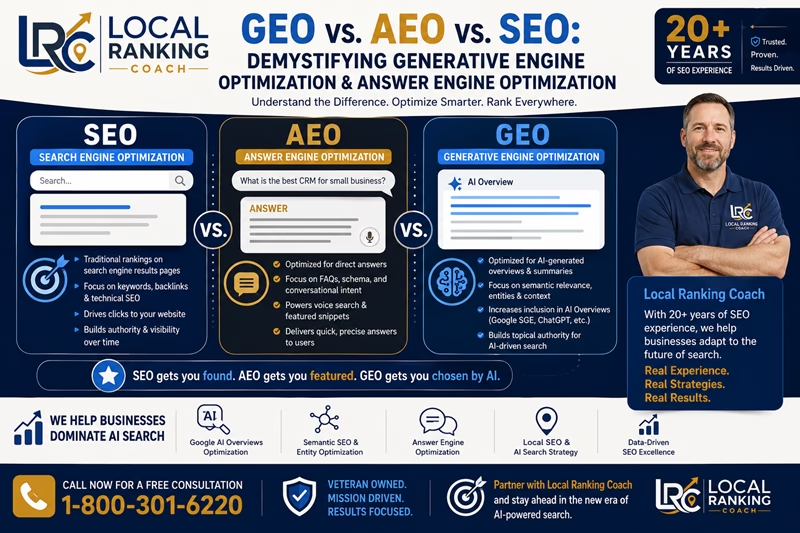
GEO vs. AEO vs. SEO: Understanding the Differences
GEO vs Traditional SEO
GEO builds on traditional seo but optimizes for how generative models select and synthesize information.
Area | SEO | GEO |
|---|---|---|
Main goal | Blue-link rankings and organic traffic | Inclusion in ai generated summaries |
Focus | Keywords, links, technical health | Entities, semantic relevance, citations |
Metric | Rankings, clicks, sessions | AI visibility, ai visibility score, share of answer |
Output | Webpage visit | Mention, citation, or attributed summary |
To measure the success of optimization efforts, it is essential to track AI citations and mentions of your brand, share of answer across key queries, and brand presence in voice results.
AEO vs SEO
AEO is not a replacement for SEO. It is a specialization focused on direct answers across search engines, answer engines, ai platforms, and voice results.
SEO aims to earn the webpage visit. AEO aims to own the answer. AEO prioritizes clarity, directness, and trust signals over traditional ranking factors, which are more relevant in SEO.
While 99% of URLs shown in AI Mode appear in the top 20 organic search results, ranking position alone does not guarantee citations in AEO. That is why content structure and attribution-ready answer blocks matter.
GEO vs AEO
GEO and AEO overlap, but they do not target the exact same output.
GEO focuses on AI-generated summaries, broad topic synthesis, and contextual authority across multiple urls.
AEO focuses on precise direct answers to specific questions.
GEO rewards semantic relevance and topic coverage.
AEO rewards answer precision, clarity, and brevity.
A smart AI SEO plan supports both.
How AI Is Transforming Search Engines
Google AI Overviews and AI Search
Google AI Overviews grew out of Search Generative Experience experiments between 2023 and 2025. They appear near the top of google search, summarize sources, and can shift user attention away from classic listings.
According to research on AI search summaries, AI Overviews can reduce external referral traffic in affected markets, especially when users get enough information without clicking through (arXiv study).
That is why semantic optimization, schema, entity clarity, and trusted citations are now essential for google ai overviews optimization.
AI Ranking Algorithms
Modern search blends classic ranking algorithms with machine learning and deep learning. Search engines no longer rely only on matching words.
Natural Language Processing and large language models help ai systems understand content, context, and user intent. Semantic indexing and entity recognition map concepts into relationships so ai search can connect “best injury lawyer near me” with local legal entities, reviews, service pages, and location data.
Even Google’s CEO has repeatedly framed AI as central to the future of search, emphasizing its importance in Google’s search strategy, which is why businesses should not wait for every detail to be publicly documented before adapting.
AI Search Ranking Factors
AI search layers add new priorities on top of traditional organic ranking factors:
Contextual relevance to the immediate question and follow-up questions.
Topical authority across multiple pages.
E-E-A-T signals such as bios, credentials, citations, and reviews.
User interaction metrics that reflect satisfaction.
Structured data implementation that clarifies entities and content types.
Semantic SEO and AI Search Optimization
What Is Semantic SEO?
Semantic SEO means optimizing for meaning, context, and relationships rather than only exact-match keywords. It helps search engines and ai systems understand how ideas connect.
Semantic relevance includes entities, synonyms, related subtopics, and user intent. For example, a page about “roof repair” may need to cover leaks, storm damage, insurance claims, emergency service, service areas, and pricing factors.
This is the foundation of both GEO and AEO.
Entity SEO for GEO and AEO
Entities are the building blocks of AI search understanding. A brand, founder, product, location, service, and industry category can all be entities.
Build entity associations with consistent naming, detailed About pages, social profiles, review sites, and schema. Knowledge graph optimization uses Organization, Person, Product, and LocalBusiness markup to reinforce who you are and what you do.
This improves both GEO and AEO because AI systems can reliably connect your brand to relevant queries.
NLP Optimization Strategies
Write in natural language that AI systems can parse easily.
Use question-based headings, answer-first paragraphs, short sections, and clear transitions. Place conversational keywords where they make sense. Re-optimize older pages that read like they were written only for crawlers.
The goal is simple: make your content useful for humans and easy for machines to interpret.
Technical SEO for AI Search Engines
Structured Data Optimization
Structured data is schema.org markup that makes content more machine-readable for search engines and answer engines. Robust schema markup provides explicit metadata for search engines.
FAQ schema supports AEO by pairing questions with concise answers. Article schema clarifies author, datePublished, dateModified, and mainEntityOfPage. Organization and LocalBusiness schema reinforce identity, contact details, and local presence.
Google’s structured data documentation is a useful starting point for implementation and validation (Google Search Central).
AI-Friendly Website Architecture
Clean architecture improves crawler efficiency and AI content retrieval. Organizing your site in a logical way can help search engines and users understand how your pages relate to the rest of your site, which is beneficial for content structuring.
Using descriptive URLs can help users understand whether a search result will be useful for them, as parts of the URL can be displayed in search results as breadcrumbs. Grouping topically similar pages in directories can help Google learn how often the URLs in individual directories change, which can affect how Google crawls and indexes your site.
That means service pages, blog posts, location pages, and resource hubs should be organized clearly. Avoid orphan pages, confusing navigation, and duplicate content.

Core Web Vitals and AI Rankings
Good user experience helps human visitors and supports search performance. Core Web Vitals include Largest Contentful Paint, Interaction to Next Paint, and Cumulative Layout Shift.
Improve performance with image compression, caching, clean code, and efficient JavaScript. Accessibility improvements like alt text, proper headings, and ARIA attributes help users, screen readers, and AI understanding.
Treat technical SEO as ongoing maintenance, not a one-time project.
Why Businesses Need GEO and AEO Strategies
The Future of Search Is AI-Driven
By 2026, ai-powered search experiences are layered into search engines, browsers, productivity tools, and social media platforms. Users expect summaries, recommendations, comparisons, and next steps.
Personalized search results make visibility more complex because ai tools may adapt answers based on location, history, and context. Without GEO and AEO, a business may rank but still be absent from ai results.
Benefits of GEO and AEO
GEO and AEO extend search engine marketing beyond clicks.
Benefits include:
Increased ai search visibility across Google AI Overviews, ChatGPT, Gemini, and Perplexity.
Better inclusion in ai overviews for commercial and informational searches.
Improving brand visibility through repeated mentions in trusted ai answers.
Higher-quality assisted conversions, even when organic traffic looks lower.
Stronger authority when your brand is cited instead of ignored.
Competitive Advantages of AI SEO
Many competitors still focus only on paid advertising, rankings, or generic blog content. That creates an opening.
Businesses that invest now can future-proof content, improve entity clarity, and prepare for multimodal ai generated content that includes text, images, video, and interactive results.
How Local Ranking Coach Helps Businesses Dominate AI Search
20+ Years of SEO Experience
Local Ranking Coach has worked through multiple eras of SEO, from early organic search to Panda, Penguin, Hummingbird, RankBrain, BERT, Helpful Content, ai overviews, and ai mode.
That experience matters because short-lived hacks rarely survive. Sustainable SEO, GEO, and AEO strategies are built on technical quality, helpful content, trust, and measurable business outcomes.
AI Search Optimization Services
Local Ranking Coach combines classic SEO with modern AI search optimization.
Services include:
Generative Engine Optimization: audits, topic clustering, entity mapping, and AI-readable content.
Answer Engine Optimization: FAQ design, answer-first rewrites, voice search optimization, and FAQ schema.
Google AI Overviews optimization: finding queries likely to trigger ai overviews and improving citation potential.
Semantic SEO: entity-based planning, internal linking, and content hubs.
Local AI SEO: helping service businesses appear in proximity-based ai answers and local ai search results.
Why Choose Local Ranking Coach
Local Ranking Coach is led with Disabled Veteran-owned values: service, integrity, and mission-driven outcomes.
The team focuses on customized strategies, not cookie-cutter templates. Every roadmap is based on industry, location, site condition, competition, and growth goals.
Reporting should connect rankings, AI visibility, leads, and business outcomes. Vanity metrics are not enough.
Common SEO, GEO, and AEO Mistakes to Avoid
Overusing Keywords Instead of Semantic Optimization
Keyword stuffing creates unnatural phrasing, poor readability, and weak contextual relevance. It can also reduce the quality of ai generated responses that might cite your page.
Instead, use related terms, entities, natural explanations, and customer-focused language.
Ignoring AI Search Optimization
Treating SEO as only “10 blue links” misses major opportunities. Brands that ignore AI search may lose impressions, brand mentions, and top-of-funnel discovery.
Weak structured data is another common issue. Add GEO and AEO checks to SEO audits, content briefs, and reporting dashboards.
Poor Content Structures
AI systems prefer content that can be broken into self-contained passages. Thin informational content, weak headings, and long text blocks make extraction harder.
Use short paragraphs, bullets, Q&A sections, and clear headings to help both users and ai crawlers.
Future Trends in GEO, AEO, and SEO
AI-Powered Search Evolution
Search will keep blending classic results with ai generated summaries, conversational assistants, and multimodal experiences.
AI assistants will become default search entry points in browsers, phones, cars, and work tools. Predictive search behavior will also grow as AI tools summarize pages, draft questions, and recommend next actions.
Future of Semantic Search
Semantic and entity-first optimization will become more important. Sites should be designed around entities and relationships, not isolated keywords.
Machine learning ranking systems will adapt by user, device, and moment. AI-generated search summaries may also include images, video snippets, and interactive content from optimized sources.
Preparing for the Future of AI SEO
Invest in semantic authority now. Build deep content hubs, use expert authors, maintain updated citations, and test what improves visibility score across ai platforms.
Partnering with experienced AI SEO experts like Local Ranking Coach helps businesses avoid fads and focus on durable optimization.
Frequently Asked Questions
How do I know if my site is being used in AI-generated answers?
Test priority queries in Google AI Overviews, ChatGPT with browsing, Gemini, Perplexity, and other major answer engines. Track brand mentions, cited URLs, and whether your content appears in ai responses.
You can also use AI visibility tools and a simple spreadsheet to record query, platform, citation, URL, and share of answer over time.
Do I need to change my entire content strategy for GEO and AEO?
Usually, no. Most businesses should adapt existing high-value pages first.
Start with your top 20–50 organic traffic pages, core service pages, and important commercial queries. Add answer-first sections, schema, better internal links, and clearer entity signals before rebuilding everything.
Is AI-generated content safe to use for GEO and AEO?
AI generated drafts can help with scale, but they must be edited, fact-checked, and improved by human experts. Low-quality ai generated content at scale can damage trust and reduce the chance of being cited in ai answers.
A safer workflow is AI for outlines and first drafts, then human review for accuracy, originality, compliance, and brand expertise.
How long does it take to see results from GEO and AEO efforts?
Minor improvements may appear within a few weeks as pages are recrawled. It is recommended to wait a few weeks to assess whether changes made to a website have beneficial effects in search results, as not all changes will result in noticeable impacts immediately.
More consistent gains often take 2–6 months, depending on crawl frequency, authority, competition, and the depth of optimization.
Can small local businesses benefit from GEO and AEO, or is this only for big brands?
Small local businesses can absolutely benefit. Local service questions, “near me” searches, pricing questions, and emergency-service queries are all areas where ai assistants may provide direct recommendations.
Strong LocalBusiness schema, detailed service pages, reviews, localized FAQs, and clear contact information can help a smaller brand win local AI visibility against larger generic competitors.
If you want your business to be found in traditional search, ai search, and answer engines, Local Ranking Coach can help you build a practical SEO, GEO, and AEO roadmap focused on leads, authority, and measurable growth.