- Key Takeways
- Introduction: From Classic SEO to Generative Engine Optimization
- What is Generative Engine Optimization (GEO)?
- Understanding Answer Engine Optimization (AEO)
- AI Search Engine Optimization Explained
- Google AI Overviews Optimization Strategies
- Large Language Model (LLM) Optimization
- Advanced LLM Optimization Techniques
- Technical SEO for AI Search Engines
- Best Practices for Generative Engine Optimization
- Common GEO & AI SEO Mistakes to Avoid
- Future of AI Search Engine Optimization
- Conclusion
-
Frequently Asked Questions (FAQ)
- How long does it take to see results from Generative Engine Optimization?
- Does GEO replace traditional SEO or Answer Engine Optimization?
- Which platforms should I prioritize for GEO in 2026?
- How can I measure success beyond organic traffic?
- Is it safe to use generative AI tools to create GEO-focused content?
Key Takeways
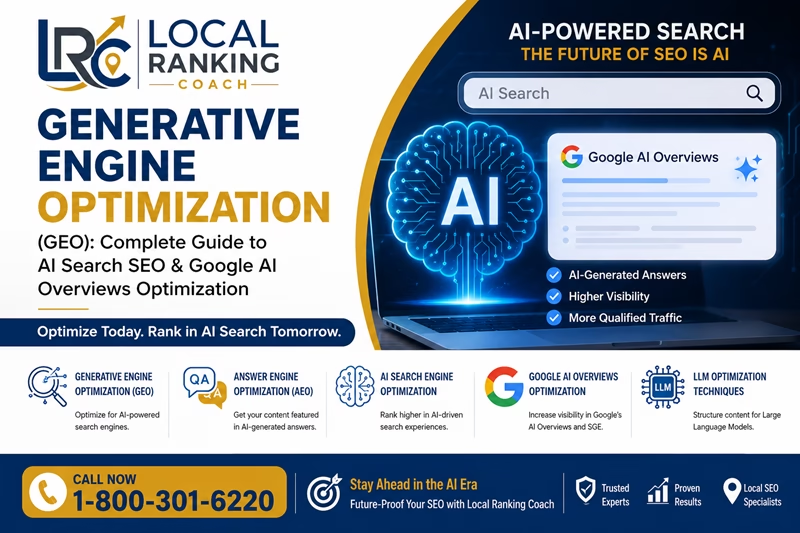
Generative engine optimization (GEO) is the practice of making your content easy for AI search systems to understand, trust, summarize, and cite. It now sits alongside search engine optimization as a core visibility channel for brands that want to appear in AI search and answer engines.
GEO structures content so ai systems like google ai overviews, ChatGPT, Perplexity, Gemini, and Bing Copilot can accurately understand, trust, and cite your brand in 2026.
By 2026, AI search and answer engines are contributing to a 25–35% reduction in traditional click-through rates on many informational queries, so brands must optimize for citations, not just search rankings.
Combining traditional seo, answer engine optimization, and GEO creates full-funnel visibility across classic google search, ai overviews, and chat-style ai search.
This blog post covers Google AI Overviews optimization, LLM optimization, technical SEO for AI, and practical optimization strategies you can apply to existing content.
Introduction: From Classic SEO to Generative Engine Optimization
In the 2010s, search was mostly about ranking among the “10 blue links.” Then came rich snippets, maps, featured snippets, and shopping boxes. By 2024–2026, search results changed again as AI Overviews and chat-based answer engines started giving users synthesized answers directly on the search results page.
Google’s Search Generative Experience beta in 2023–2024 evolved into broad google ai overviews rollout in 2024–2025, changing how people interact with search engine results pages.
Answer engines such as ChatGPT, Perplexity, Gemini, and Claude deliver summarized ai generated answers instead of pure link lists.
answer engine optimization (AEO) focuses on becoming the direct answer; GEO extends that to generative ai systems and LLM-based search.
Businesses now need ai seo that protects search visibility through citations, brand mentions, and “share of answer,” not only search engine rankings.
Local Ranking Coach helps businesses adapt their digital strategy for this ai era by combining local SEO, semantic SEO, and generative engine optimization.

What is Generative Engine Optimization (GEO)?
Definition of Generative Engine Optimization
Generative Engine Optimization is the process of optimizing digital content so AI-powered search engines, chatbots, and generative engines can discover, interpret, summarize, and cite it accurately. SEO focuses on keyword targeting and rankings while GEO emphasizes content clarity and structure for AI extraction.
GEO applies to Google AI Overviews, Bing Copilot, ChatGPT’s web search, Perplexity, Gemini, and other ai engines. Unlike traditional seo methods that primarily optimize pages for blue links, GEO optimizes for ai generated responses, conversational summaries, and assisted conversions.
This matters because AI Overviews can reduce clicks while making brand citations more valuable. If your content appears in an AI summary, your website’s visibility may grow even when fewer users click every organic result.
Why GEO Matters in AI Search
User behavior has shifted toward longer search queries, follow-up prompts, and conversational search optimization. People now ask “what should I do next?” rather than typing only relevant keywords.
AI Overviews now appear for a large share of informational queries; Ahrefs found position-one CTR can drop about 34.5% when an AI Overview appears.
AI search engines use machine learning algorithms to rank passages, entities, and facts, not just URLs.
GEO helps capture users moving away from standard text searches by ensuring visibility in AI summary queries.
AI for SEO represents a paradigm shift in digital marketing, combining machine learning algorithms and data analysis to enhance seo practices.
GEO is now central to marketing strategies in finance, healthcare, ecommerce, local services, and other competitive markets.
According to Semrush, in 2025, visitors arriving through AI search have a conversion rate 4.4 times higher than those from traditional organic search, highlighting the importance of AEO for enhancing visibility and credibility.
How AI Search Engines Process Content
AI search engines interpret web data through different frameworks compared to traditional search. They work on meaning, entities, structure, and source confidence rather than only exact-match keyword density.
Semantic indexing breaks pages into passages and maps them into vector spaces for vector search optimization.
Entity recognition extracts brands, people, products, places, and categories, then connects them to knowledge graph SEO.
natural language processing parses headings, questions, direct answer blocks, and relationships between sections.
large language models such as GPT‑4.1, Gemini 1.5, and Claude 3.5 use retrieved passages to create ai responses.
Knowledge graph interpretation improves when structured Schema and consistent formatting across platforms are vital for improving brand trust in AI models.
AI systems pull data from highly structured, authoritative sources, making GEO strategies essential for creators to secure citations in conversational summaries.
Understanding Answer Engine Optimization (AEO)
What is Answer Engine Optimization?
Answer engine optimization is the practice of structuring content so AI systems can understand, trust, and cite your brand as the direct answer to a query, focusing on extractability, clarity, and trust signals rather than traditional ranking factors. SEO helps pages rank; AEO helps answers get selected; GEO helps generative engines reuse and cite those answers.
AEO targets voice assistants, featured snippets, AI Overviews, chatbots, and ai answer engines.
Voice and chat interfaces are rising because user queries are increasingly spoken or conversational.
Effective AEO requires content that is clear, structured, and easy for AI systems to extract and attribute, including leading with a direct answer, using question-based headings, and implementing structured data and FAQ schema.
AEO is the foundation of GEO because clear answer blocks give generative engines reliable building material.
How Answer Engines Rank Content
Answer engines rank content by clarity, authority, topical relevance, and trust. Exact-match keywords still help, but they are no longer enough.
Authority signals include backlinks, brand reputation, author credentials, trusted citations, and third-party reviews.
Topical completeness matters because pages that answer related questions reduce content gaps.
Entity relationships such as brand–location–service–reviews help answer engines choose reliable sources.
Many AI Overviews cite sources already visible in the top 10–20 search engine results, but they apply extra filters for factual extractability.
Maintaining a strong presence in trusted third-party review ecosystems can improve brand visibility to AI.
Core Components of AEO
Use this as a practical checklist:
Add FAQ schema and Q&A formatting for machine-readable answer blocks.
Use entity-based optimization with consistent names, addresses, categories, and author bios.
Start H2s and H3s with “what,” “how,” “why,” and “when,” then give a concise 30–60 word answer.
Support each answer with data, examples, and authoritative references.
Optimize for passage indexing with short paragraphs and clear subheadings.
AI Search Engine Optimization Explained
What is AI Search Engine Optimization?
AI Search Engine Optimization is the broader discipline of optimizing content, entities, structured data, and page experience for AI-mediated discovery across search engines, chatbots, and assistants. It blends classic search engine optimization with AI content optimization, semantic SEO, and large language model optimization.
AI-driven search uses ai algorithms, semantic ranking, vector retrieval, and generative ai. Traditional search engines rely more heavily on classic search algorithms and link-based signals.
AI SEO covers content creation, structured data, entities, page speed, and crawlability.
GEO is a specialized subset of AI SEO focused on generative engine answers.
The integration of AI into SEO practices marks a significant shift, transforming how businesses approach search engine optimization by enhancing keyword research, content creation, and predictive analytics.
Key AI Search Ranking Factors
Factor | Why it matters |
|---|---|
Semantic relevance | Aligns content with user intent, search queries, and related questions. |
Content depth | E‑E‑A‑T signals, bios, dates, and expertise help AI trust the source. |
Internal linking | Topic clusters show pillar and supporting relationships. |
Engagement | Lower bounce rates and useful sessions can support seo performance. |
Entity validation | NAP consistency, reviews, profiles, and reputable mentions confirm identity. |
AI enhances SEO by automating keyword research, optimizing content creation, predicting search trends, analyzing competitor strategies, and personalizing user experiences to boost rankings.
AI Search Optimization Strategies
A 60–90 day plan should focus on the pages with the highest business value first.
Build topic clusters around core entities, problems, and relevant queries.
Create entity-rich content that names products, services, locations, industries, and experts clearly.
Optimize for conversational search with natural follow-up questions.
Use structured data markup such as Article, FAQPage, HowTo, Product, LocalBusiness, and Organization.
Use NLP SEO with synonyms, related phrases, and intent terms instead of repeating one keyword.
AI-powered tools can automate time-consuming tasks such as keyword research, content optimization, and link building, allowing marketers to focus on strategic planning and creative initiatives.
Google AI Overviews Optimization Strategies
What Are Google AI Overviews?
Google AI Overviews are AI-generated summaries that appear above or within search engine results for selected queries. They combine relevant information from multiple sources into a synthesized answer.
AI Overviews often cite several pages and may appear above organic listings.
Google appears to select sources based on relevance, authority, clarity, and factual support.
A Search Engine Journal field study reported AI Overviews reduced outbound clicks by 38% on triggered queries.
Google AI Overviews optimization is now a key part of GEO SEO.
How to Optimize for Google AI Overviews
Strong fundamentals still matter, but AI search engines prioritize scannable data and factual extractability for generating answers.
Write factual, well-cited, error-free content aligned with Google’s helpful content guidance.
Use semantic headings, short answer paragraphs, and supporting detail.
Add expert quotes, case studies, original data, and verifiable metrics.
Build topic authority by covering related subtopics and interlinking them.
Embedding verifiable metrics and connecting claims to authoritative references enhances content trustworthiness. Generative engines reward clear and concise content, integrating unique statistics and expert quotes for credibility.
Technical SEO for AI Overviews
Technical SEO still underpins GEO success because crawlers must access and parse your content.
Validate schema with tools such as Google’s Rich Results Test.
Improve Core Web Vitals and page speed.
Use mobile-first design, accessible layouts, and fast loading.
Maintain XML sitemaps, accurate robots.txt, and canonical tags.
Use clean HTML and logical heading hierarchy.
Utilizing Server-Side Rendering or Static Site Generation is recommended for ensuring text accessibility for AI crawlers. Avoiding complex JavaScript and using clean code facilitates better access for AI crawlers.
Content Formatting for AI Extraction
AI models favor content that is structured with clear headings, bulleted lists, and schema markup, which enhances machine readability.
Use bullet points, numbered lists, and short paragraphs.
Add definition blocks for terms such as generative engine optimization and answer engine optimization.
Put 30–60 word answers directly under question headings.
Use tables for comparisons such as SEO vs AEO vs GEO.
Add 3–5 FAQs to important pages.
Utilizing direct answers and anticipating user follow-up questions enhances content visibility in AI-generated summaries.

Large Language Model (LLM) Optimization
What is LLM Optimization?
LLM optimization shapes your content so large language models can accurately interpret, retrieve, and represent your brand. In search, many AI systems use retrieval-augmented generation, where passages are pulled from web content or knowledge bases before the model generates an answer.
For marketers, LLM optimization techniques focus on semantics, structure, and entities rather than GPU infrastructure. Well-optimized content improves the chance that your brand is retrieved, cited, and paraphrased correctly.
How LLMs Understand Semantic SEO
LLMs model concepts as tokens, relationships, and embeddings rather than simple pages.
Named entities must be consistent across your site and external profiles.
Context windows help ai models interpret surrounding sentences and sections.
Token relationships and semantic embeddings reward coherent, focused writing.
Vector search relevance improves when pages are semantically rich and not thin.
Maintaining identical bio details and definitions across platforms aids in unifying digital entities to boost visibility.
LLM Optimization Techniques
Use this checklist for content and SEO teams:
Write entity-first: name your brand, service, location, and category early.
Use semantic keyword clustering around topics, not scattered thin pages.
Map topic authority around customer problems and use cases.
Use data analysis and ai tools to identify which sections earn citations or relevant traffic.
Add clear “is-a” and “part-of” statements for knowledge graph optimization.
Mirror prompts in headings, such as “how do I,” “what is,” and “best way to.”
AI-powered keyword research tools streamline the process of finding valuable keywords by analyzing vast amounts of data to identify high-value keywords that can drive organic traffic.
Advanced LLM Optimization Techniques
Entity SEO for AI Systems
Entity SEO is the backbone of both AEO and GEO. It tells ai systems who you are, what you do, where you operate, and which topics you should be associated with.
Build strong links between your brand, services, industries, and locations.
Use Organization, Person, Product, and LocalBusiness schema to connect with the Google Knowledge Graph.
Keep NAP details consistent across your website, Google Business Profile, and directories.
Earn mentions from authoritative publications and review platforms.
Implementing GEO requires adapting content design for machine-trusted authority models and ensuring source credibility.
Semantic Content Architecture
Semantic content architecture is how topics, URLs, headings, and internal links are organized for meaning.
Create pillar pages such as “AI Search Engine Optimization” supported by cluster pages like “Google AI Overviews Optimization.”
Use H1, H2, and H3 headings that match task flows.
Use contextual anchors, not generic “click here” text.
Audit and merge thin pages into stronger resources.
Unlike SEO, GEO targets visibility in AI overviews and conversational interfaces, focusing on semantic relevance and authoritative context.
NLP-Based Content Optimization
You do not need to overuse jargon to benefit from NLP principles.
Use semantic similarity and related terms naturally instead of relying on old-school latent semantic indexing (LSI) myths.
Keep sentence flow clear for readers and parsers.
Use conversational patterns, examples, and plain explanations.
Match informational, transactional, navigational, and local intent with the right CTA.
AI algorithms can optimize keyword targeting by analyzing user intent, search trends, and competitor strategies to identify the most relevant and impactful keywords for a business. AI excels at identifying long-tail keywords, which are specific, niche phrases that may have lower search volumes but higher conversion rates, allowing businesses to target more precise audience segments.
AI Retrieval Optimization
Retrieval-augmented generation, or RAG, means an AI system retrieves relevant passages before generating an answer. That makes chunkable, factual, well-labeled content more valuable.
Keep paragraphs to 1–3 sentences and one idea.
Use descriptive headings for easy indexing.
Add FAQs, summaries, bullets, and tables.
Reinforce claims with dates, numbers, and sources from 2024–2026.
A 2026 study on AI Overviews found that about 11% of atomic claims were unsupported by cited sources, which makes source clarity and verification even more important.
Technical SEO for AI Search Engines
Structured Data Optimization
Structured data acts like an API between your site and AI systems.
Implement JSON‑LD schema for Article, BlogPosting, FAQPage, HowTo, Product, LocalBusiness, and Organization.
Use FAQ schema for AEO and GEO, matching visible page content.
Use Organization and LocalBusiness schema to strengthen entity identity.
Add Article schema with author, datePublished, dateModified, and headline.
Core Web Vitals and AI Rankings
AI-driven clicks are precious because they often come from users who already received a summary.
Optimize LCP, INP, and CLS.
Use responsive design for mobile users.
Improve engagement with fast pages and clear navigation.
GEO emphasizes content structure, depth, and clarity to improve engagement and reduce website bounce rates.
Crawlability for AI Systems
If crawlers cannot reach content, no engine optimization tactic will matter.
Maintain updated XML sitemaps.
Configure robots.txt carefully.
Use canonical tags to consolidate duplicates.
Keep important pages within a few clicks from the homepage.
Make sure meta descriptions accurately summarize pages for humans and parsers.
Best Practices for Generative Engine Optimization
Content Best Practices
Write for people first, but format for machines.
Write for topics and entities, not isolated relevant keywords.
Cover definitions, how‑tos, pros and cons, examples, and FAQs.
Create authoritative long-form content for complex topics, broken into scannable sections.
Add expert-driven insights, original data, and recent citations.
As AI technologies evolve, the future of SEO will likely involve a blend of traditional SEO practices and new AI-driven strategies, ensuring that SEO remains a critical component of digital marketing.
Technical Best Practices
Content and technical foundations must work together.
Validate structured data in Search Console.
Use HTTPS, compressed images, and modern formats.
Use crawl analysis to find orphan pages and blocked sections.
Keep semantic HTML clean and avoid layout-breaking scripts.
User Experience Optimization
UX supports engagement signals and conversions from AI-referred visitors.
Use clear navigation and breadcrumbs.
Improve readability with spacing, contrast, and short sections.
Put quick answers first and deeper detail below.
Match CTAs to intent, especially for visitors from ai results or personalized search results.

Common GEO & AI SEO Mistakes to Avoid
Over-Optimizing Keywords
Keyword stuffing hurts readers and confuses AI interpretation. Generative engines prefer natural, useful, conversational writing.
Avoid repeating exact phrases unnaturally.
Use synonyms and related concepts.
Focus on user questions, problems, and target audience needs.
Do not chase keyword density at the expense of clarity.
Ignoring Entity Relationships
Inconsistent entity data makes ai systems unsure about who you are.
Avoid mismatched brand names, addresses, product names, or bios.
Connect brand, category, location, and services in copy and schema.
Disambiguate your brand from similarly named companies.
Review existing content to identify content gaps and entity confusion.
Weak Content Structures
Good information can underperform if it is buried.
Avoid chaotic heading structures.
Add schema markup for FAQs, articles, and how‑tos.
Expand thin pages under 300–500 words when the topic needs depth.
Consolidate scattered posts into GEO-ready guides.
Future of AI Search Engine Optimization
Evolution of Search Generative Experiences
Search technology will keep moving toward AI-first interfaces through 2026 and beyond.
Chat and voice will become default for complex research.
Multimodal answers with images, videos, and charts will become more common.
Personalized AI-generated answers will use user history, location, and preferences.
Predictive SEO and AI
AI-driven predictive analytics will enable marketers to anticipate changes in search engine algorithms and user behavior with greater accuracy, allowing for real-time adjustments to SEO strategies.
Use AI analytics to spot emerging questions before they peak in keyword tools.
Test page structures to see what performs in generative search.
Expect greater emphasis on source transparency, provenance, and factual reliability.
Use ai powered tools for automating repetitive tasks, but keep strategy human-led.
Preparing for the Future of GEO
Future-ready brands invest in semantic authority and flexible content systems.
Build evergreen hubs around your audience’s biggest problems.
Invest in entity SEO as a hedge against search engine algorithms changing.
Rework pages quickly as AI indexing and search algorithms evolve.
Track ai visibility, site’s visibility, and search results performance together.
Conclusion
Why GEO and AI Search Optimization Matter
AI is now a core layer of search, not a side feature. Brands that rely only on classic search engine results may lose visibility as users shift toward ai generated answers and conversational interfaces.
Businesses must go beyond traditional seo to compete in ai search, answer engines, and generative interfaces.
Semantic relevance, entity clarity, structured data, and concise answers now define success.
GEO, AEO, and AI SEO protect brand visibility as zero-click behavior grows.
Next Steps for Implementing GEO
Start in phases instead of trying to rebuild everything at once.
First 30 days: audit priority pages, check schema, review entity consistency, and map important user queries.
Days 30–60: restructure content into answer-first formats, add FAQs, improve internal links, and refine on page optimization.
Days 60–90: monitor AI citations, ai overviews appearances, engagement, conversions, and assisted revenue.
Keep learning because search technology, ai models, and ai engines are changing quickly.
If you want help turning GEO into a practical local growth plan, Local Ranking Coach can help improve your ai visibility, build semantic authority, and prepare your content for AI-powered search.
Frequently Asked Questions (FAQ)
How long does it take to see results from Generative Engine Optimization?
Sites with strong SEO foundations may see early improvements in citations or Google AI Overview presence within a few weeks. Full GEO impact on brand visibility, relevant traffic, and assisted conversions usually takes 3–6 months.
Does GEO replace traditional SEO or Answer Engine Optimization?
No. GEO does not replace SEO or AEO. SEO is still vital for search engine rankings, AEO helps you become the direct answer, and GEO helps your content appear in generative engine summaries.
Which platforms should I prioritize for GEO in 2026?
Prioritize Google Search, Google AI Overviews, Bing Copilot, ChatGPT with browsing, Perplexity, and Gemini. Good GEO practices usually transfer across most major AI-powered search engines and ai answer engines.
How can I measure success beyond organic traffic?
Track AI citations, share of answer, branded mentions inside AI responses, AI-referred conversions, voice assistant visibility, and engagement from AI-driven visits. Raw sessions are no longer the only metric that matters.
Is it safe to use generative AI tools to create GEO-focused content?
Yes, but use generative AI carefully. ai tools can speed up research, outlines, advertising campaigns, and drafting, but human experts should verify facts, add original insight, check legal accuracy, and optimize structure for GEO, AEO, and SEO.